Hello everybody! Welcome to yet another week of my anime blog! As usual, I got a good one for yall! This week we will be talking about Ah! My Goddess, or Oh, My Goddess! To-may-to, to-mah-to, whatever you prefer. We are actually going to be talking about the movie, not the series, just so we are all clear with that.
Now, seeing as how I haven't watched a single episode of the series before watching this series, I think that it is no surprise that I was a tad bit lost at the beginning of the movie. Like, who or what the hell is this?
Looks cute, but I don't even know...
Yeah, I really don't know.
Nevertheless, I was able to put some pieces together. It took me a little bit, but I eventually figured out that Belldandy and Keiichi were in a relationship. I also figured out that Belldandy was a goddess. Yeah.
I can also tell that this show probably has a comedic element too. I was laughing pretty loudly during the scene where Megumi and Sora are drunk. Really. Loudly.
Hilarity.
Now, in all seriousness, there are some interesting points that I feel I should bring up. For one, a theme similar to that which we discussed in Princess Mononoke: women and power. I noticed, at least from what I gathered from the movie, that women pretty much have all of the power in Heaven, with the exception of the major head honcho, which I'm assuming is God, and also a male. He is only a floating voice, and only makes an "appearance" (he is never actually seen) in a very small part in the movie. Other than that, the females make all of the big decisions in the movie.
Also, true to Japanese culture, and apparent in most anime, the lines between good and evil are not at all clear or defined. The antagonist, Celestin, is the perfect example of this. His intentions are good-hearted; he wants to end all suffering and hurt in the world. How he plans on carrying out these ideals are questionable though. He erases Belldandy's memories of Keiichi, and uses her. And in order for all suffering to end, a new Earth would have to be created, consequently destroying the current Earth. Of course, this never happens.
I also find it interesting that all of the protagonists are fighting to keep a world essentially where suffering is everywhere. You would think that they would also want suffering in the world to end, but I guess this movie teaches that suffering is an essential part of living.
Hello to everyone and welcome to another week of my anime blog! I took a couple of weeks off, but do not fret! I am back! And I have a good one for y'all this week too: Princess Mononoke! Yes, we are going to be discussing Hayao Miyazaki's classic anime film this week, and I could not be more excited. So lets get started.
As to be expected, there are quite a few issues and conflicts in the film. One of these conflicts is between the animals and the humans. The animals are fighting to keep their forests, while the humans want to tear it down for their own resources. In order to do so, the humans of Irontown decide to kill the Forest Spirit, which in turn will destroy the forest and drive away all of the animals. This brings up a real-life issue all too well known throughout the history of humans and the world: humans versus nature. Despite the fact that we humans are a part of nature, we continually fight against it through new technological advances that supposedly make life easier. In the process, however, we destroy the environment that we live in, and that will eventually lead to our demise. In the end, nature will win.
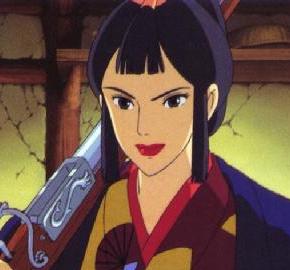
One thing I find particularly interesting about the film is Irontown and its inhabitants. Though they are the enemies of the animals and intend to destroy the forest, they are not necessarily an evil town. The town is made up of lepers and woman who have been rescued from brothels, and they, for the most part, are a tightly-knit and good-hearted community. Also, women have a powerful role in the town--Irontown is run by a woman, and the female inhabitants do much of the hard work and make the town profitable. However, they are not an ideal town, mostly because of the constant outside threats. Still though, it is a morally ambiguous town, for when they are defeated by Ashitaka and San, Eboshi, the leader of the town, promises that she will do things better, but it is unclear whether she has "good" intentions or not.
Hello everyone. Today I am a somber, sad blogger, for this week is part two of our World War II theme, and today we are discussing Grave of the Fireflies. Yes, I would think it to be very much of an understatement when I say that this movie is very, very sad and heartbreaking. However, despite this, the movie still remains to be one of true beauty. More so than any of the movies we have discussed this semester, it is the best example of mono no aware, which basically means that life is beautiful, yet impermanent.
Seita, 14, and his little sister, Setsuko, 4, have a love for each other that, despite all of their hardships, stays strong to the very end. They are both caught in a massive firebombing which leaves their town destroyed and their mother dead. As a result, they must move in with their aunt who treats them badly, and the whole time, Seita takes care of his sister before anyone else, including himself. Sooner than later, they both make the decision to get away from their aunt, which leaves them truly on their own. While they are living on their own, food becomes scarce and Setsuko becomes very sick. She begins to eat marbles and makes "rice cakes" made out of dirt for Seita, who then begins to cry. I believe this is one scene that really shows exactly how much love Seita and Setsuko have for each other.
Also, this movie shows how indifferent many people are towards others' suffering. There is one scene where Seita goes inside of a building and overhears a conversation talking about how the war is over. He then frantically asks a nearby man about it and then begs the man to tell him about what happened to the Navy fleet in which his father was stationed, but the man simply brushes him off and calls him crazy. There is also another scene where Seita is stealing food from a farm. The farmer catches him, and despite Seita's pleas about him and sister's starvation, he still takes him to the police, and on top of that, pretty much drags him away from his sister.
What I find really interesting though, is that the native Japanese are seen as more of the bad guy than the Americans. The Japanese are the ones that are knowingly treating the two children badly, not the Americans. The Americans are just mindless robots in this film.
Hey everybody and welcome to another week of my anime blog! This week will be the first of a two-part feature on World War II movies; today we are discussing "Harp of Burma."
This movie is an animated adaptation of Michio Takeyama's book of the same title, and considering that this movie is part of the same compilation of anime classics as Botchan, the animation style is very simple; backgrounds tend not to move, movements are jerky, and color scenes are not very vibrant. However, despite each of these little shortcomings, this movies is truly beautiful. It tells the story of a squadron of Japanese soldiers fighting in World War II; it focuses on one soldier in particular, though: Mizushima, who plays a Burmese harp. Everytime the soldiers are feeling down (which I imagine is pretty often), they sing, and Mizushima plays his harp in the background. Once the war is over, they are all sent to a POW camp, all except for Mizushima, that is. He is instead sent to go with another squadron, and for the most part disappears altogether eventually. Of course, his fellow soldiers miss him dearly, so when they come across a Burmese monk one day that bears an exact resemblance to him, they become excited. However, the monk ignores them. Then, they find out that the monk plays the Burmese harp, and they become more and more convinced that the monk is actually Mizushima. The monk however continues to ignore them, so by the time they are allowed to leave the camp to go back home to Japan, they are forced to give up on trying to get the monk to return with them.
And guess what?
As it turns out, the monk actually is indeed Mizushima, as revealed in a letter written to the soldiers from Mizushima himself. He told them that he wanted to go home with them badly, but he felt that it was his duty to stay and bury all of dead soldiers that were left to rot in the elements. He knew that this task would take up most, if not all of his life, so he knew that he probably would never see any of his brethren again.
Now, his story brings up an interesting difference between the American and Japanese cultures. In America, heroes may encounter hardship after hardship in their endeavors, but always is rewarded in the end. For example, Simba, despite having to watch his father die and then deal with his evil uncle, still becomes king of the his pride in the end. This is just in terms of entertainment though; religion is the same way as well, case in point, Christianity. If you remain a relatively good person and repent for all your sins, you will be rewarded with Heaven.
Japan is different, however, in that its culture provides a bleaker, more realistic outlook on life. Mizushima will be burying soldiers' bodies for the rest of his life, but he won't be rewarded at all. He won't see his brothers. He won't go to Heaven. This doesn't change the fact that he is doing an extremely good deed and overall is a very good person, but this sense of respect and self-satisfaction is what keeps him going. He is not expecting a grand reward when all is said and done.
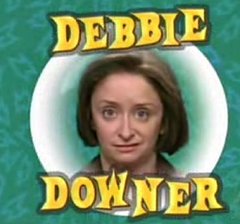
I guess in this sense you could say that Japan is the Debbie Downer of the world.
Hey everybody! Welcome to yet another week of my anime blog. This week I'm going to do things just a little differently; instead of focusing exclusively on a single movie, I'm going to revisit some of the movies and themes from past blogs and relate them to today's movie. Don't get me wrong though, we will definitely get to thouroughly analyze this week's featured movie, which, by the way, is Ghost in the Shell.
Now, what could these three movies possibly have in common with one another other than being anime cult classics? How are a teenager granted with psychic powers, an insane celebrity, and a cyborg that works for a security force related. Well, what unites these three wonderful movies is one universal theme: identity.
In Akira, Tetsuo has much difficulty coming to terms with his identity; he is the baby of his motorcycle gang, but refuses to accept this. So, when he is given Akira's psychic powers, he becomes someone completely different, and by the end of the movie, Tetsuo's identity is unclear; is he Tetsuo or is he Akira?
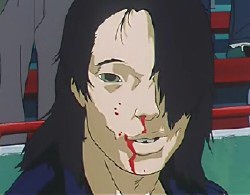
In Perfect Blue, Mima, who is an ex-pop idol turned actress, also has issues with her identity. Because of her career change, her old fans are determined to make sure that she turns back into a pop idol. Also, it does not help that she doesn't like many of the roles and scenes that she is doing as an actress. However, she is determined to change her pop idol identity by taking on more mature roles. As a result of all this pressure, she begins seeing hallucinations of her former self, which confuses her even more. Even at the end of the movie, though all is dandy, she has to convince herself that she is real.
Now, time for Ghost in the Shell.
Major Motoko Kusanagi is a cyborg and is part of a government security force called Section 9.
Well, actually, she is only 95% cyborg...and this is where things get a tad bit complicated. And I might add that to say that this movie get REALLY deep. No kidding though, it's definitely more of a philosophical-make-you-think-a-lot movie rather than your typical mecha anime, but I will try to explain a little bit.
Anyways, back to the Major.
So yeah, she is 95% cyborg, which means that she still has some humanity in her, albeit just a trace. Throughout the movie, she questions what exactly it means to be human. And then, there's the issue of "ghosts," which are the cyborgs' equivalent of a soul and conscience. So while the Major is already having identity issues, someone called the Puppet Master comes along and wants to fuse ghosts with her in order to become a single entity. While this is happening her body gets destroyed, so afterwards she is put into a child's body. Once again, identity is unclear by the end of the film; is she still Motoko Kusanagi, or has the fusion with the Puppet Master changed her?
Before I go, yall know me....I have to include something about the soundtrack. Kenji Kawai did this soundtrack, so I already know it's good. And just so yall know, he also did the soundtrack to Higurashi no naku Koro Ni, which is an AMAZING anime with an AMAZING soundtrack. So definitely check it out. Only if you like creepy choral horror music.
Greetings to all of you wonderful anime fans! I am not going to lie, I'm feeling just a little hyper as I write this blog, so I may or may not be all over the place. Just do me a favor and at least TRY to follow along with my train of thought here. Kay, thanks.
Well, this week we are going to talk about Vampire Hunter D, which to be quite honest, is definitely NOT one of my favorite movies.
In fact, I would probably call it THE worst of the movies we've watched so far. It absolutely failed to get a hold of my attention, and I wanted it to end after the first thirty or so minutes. Unfortunately, I had to wait another hour.
Oh, life.....
The plot seemed interesting; a vampire who himself is a half vampire/half human must save a damsel in distress from a very, very old vampire. Actually, it's a pretty generic plot, but considering that this movie was made in 1985, I'll forgive it for that, but NOTHING ELSE.
The characters generally possessed little to no depth, including the title character. I must say that the characters were all really annoying as well, especially the girl (her name escapes me) and her little brother.
I had HIGH expectations for this movie, as it is considered to be a cult classic, but I think it's needless to say that I was extremely disappointed. I'd rather be tied to a chair surrounded by crazy Twilight fan-girls at the premiere of Breaking Dawn: Part 1.
I think I'll have a better chance with the zombies...
Okay, I'd actually watch Vampire Hunter D again in that case....I'm not suicidal. Maybe we can upgrade it to simply sitting down and watching Queen of the Damned? ughhhh.....*shivers*
Don't get me wrong though, I LOVE VAMPIRES. I've read most of the Sookie Stackhouse/Southern Vampire series, and seen a little bit ofTrue Blood.....and it's excellent. I've also seen a number of other vampire movies including, Underworld 1,2, and 3, Interview With a Vampire, I Am Legend, The Lost Boys, and Let The Right One In (probably one of my favorites).
And for you anime fans, I suggest you go watch Hellsing, Blood +, Trinity Blood, or ANY other vampire anime before watching this one.
Hellsing, a much better vampire anime
Before I conclude this post, might I add that Deidara from Naruto has a very similar hand to that of D's. Their names also start with a D. I think that's pretty much all that they have in common.
Hey everyone! Welcome to yet another weekly installment of my anime blog! This week we are talking about one of my favorite anime movies of all time, Perfect Blue.
Considering that this is a Satoshi Kon film, we already know this it is strife with issues surrounding reality vs. fantasy, identity, and technology. That means we have a LOT to talk about, so lets just get right into it.
Perfect Blue is a psychological thriller...with emphasis on the PSYCHO. Not even kidding though, it really messes with your mind.
Mima, the main character, is an ex-pop idol getting ready to reinvent herself as an actress. However, this new life proves to be trying on her mental stability. She is forced to play more mature roles and take on more mature themes, such as rape and murder. Of course, all of the fanboys and girls Mima "The Pop Idol" are vehemently opposed to this new Mima, so she has that burden as well. In addition, one of these fanboys, an especially creepy fanboy, has created a fan site for Mima fans, supposedly updated by Mima herself. Of course this is not actually her, but Me-Mania, the creepy fanboy, seems to know all of the details of her daily endeavors, and also adds extra details.
Me-Mania in all of his creepyness.....
Basically, the website is what Me-Mania and all the rest of the Mima fandom WANT Mima to be, and this is where the question of reality vs. fantasy comes in, because Mima lets all of this get to her, and she begins to get confused about what is reality and what is not. The website also confuses her about her identity, for the Mima on the website seems just like her. She begins seeing hallucinations of her as her pop-idol self, and the latter torments Mima throughout the entire film.
Might I also add that I am absolutely FASCINATED with the film's soundtrack. One song in particular that pops up numerous times is called "Virtua Mima." It is absolutely creepy and most definitely adds another layer of depth to the scenes in which it accompanies.
I feel like I also should add in a tribute to Satoshi Kon and all of his most famous works. RIP
Welcome again everybody to my blog! This week I'm going take a break from all the rape and gore from previous weeks and take a turn towards something a little more light-hearted.
Just a little.
I speak of School Days and Botchan of course. Both of these anime deal with school life in Japan...and none of it is pretty.
School Days deals with a young man named Kenkichi who is trying to get into college. It is a tough, competitive, and stressful process in which everyone must study and take a test. Of course, though, there are distractions, such as stupid siblings and stupid love. Long story short, while Kenkichi was studying, he meets the love of his life, or so he thinks. His little brother comes along to study for the same test, although he does not take it as seriously. He also steals Kenkichi's girl while he's at it. Kenkichi plans to marry the girl once he passes the test, except he doesn't really pass the test. And to add insult to injury, his little brother passes it AND gets the girl. So Kenkichi goes and kills himself.
SEPPUKU!!!!
I told you it was a little more lighthearted, didn't I?
Botchan is a little better.
Botchan is a school teacher who transfers from Tokyo to some hole in the road elsewhere in Japan. He is ridiculed by his students, and taken advantage of by some of his colleagues. The students play many different hi-jinks on him, provoked by the vice-principal unbeknownst to Botchan. After his colleagues get fired one by one, Botchan teams up with them to scare the you-know-what out of the bad colleagues. He then leaves afterwards. YOU GO BOTCHAN.
Considering that I went to a pretty bourgeois high school , I can't really relate to most of the stuff that goes on in both of these films, even in my freshman year, where my entire class was eleven people. I repeat--ELEVEN FRICKIN PEOPLE. However, we didn't really play tricks on the teachers or anything like that. And later on, after I changed schools, nothing really changed. I was just around more people.
Yeah, I had a pretty dull four years...
Hey everybody! Have yall recovered from the gory, action-packed, confusing-as-hell Akira? Whether you did or not, it really doesn't matter, because this week I'm going to be talking about Ninja Scroll, which, while certainly less confusing, is certainly action-packed and filled with lots of gory, limb ripping, and blood-gushing goodness.
image taken from bloodsprayer.com
There are also sexy nude women.
Well, technically, only one of them is nude the whole time she is on screen, but that's not really what I came here to talk about. Rather, I'd prefer to talk about one of these women, Kagero.
She is the heroine of the film, and the only female ninja of the Koga clan (to my knowledge). Why, in ancient Japan, does she have such high, or rather unusual, rank in society? The truth is that she is poisonous....literally. Any one that she sleeps with....well, to put it simply, just dies. While possessing this ability, she however remains a noble, loyal character, and it is this that makes her the most tragic character in this film.
This poison that lives in her is both a curse and a blessing; she cannot have any sort of intimate relationship with any other person...without that person dying of course. However, this poison also prevents others from raping her, or at least exacts some unpleasant revenge on those who try. For example, there is a scene where an oni made of rock, named Tessai, has captured her and proceeded to rape her, but he only gets so far before Jubei, the hero of the film, interrupts.
image taken from 4.bp.blogspot.com
Jubei and Tessai proceed to fight, during which Tessai's rocky exoskeleton begins to crumble. While Jubei thinks that this is his own doing, he does not realize that the effects of Kagero's poison are starting to take. This ability is especially important considering the time period in which this movie takes place, the Tokugawa shogunate, in which women were not valued much, and men were free to do with them whatever they wanted. And in this time of increasing immorality, she was a sort of gem, or so to speak, because of her poison.
However, throughout the course of the film, she and Jubei grow close. Really close. The same ability that protects her, actually hurts and limits her in this case. She cannot get physically intimate with him, or else, as we all know already, he will die. Here is the thing though: he is already poisoned, and her poison would actually save him. She soon figures this out, but then, of course, in a peak moment of tragic-ness,- she is killed. She does share one kiss with him before passing away, and this proves to be a bittersweet ending to her character.
Hey everyone! I want to welcome you to the first REAL post of my blog. Yayyyyyy!
Every week I'm going to review a classic anime film and then go through some of the themes, elements, and issues that present themselves in the film. While I won't give a summary or so to speak, I will warn you though that there WILL be spoilers for most, if not all of the movies I feature on this blog. I repeat: There WILL BE SPOILERS.
Now that we've got that out of the way....
This week I'm going to talk about one of the most groundbreaking, mind boggling, and visually captivating anime films of all time: Akira.
Akira Movie Poster
If you're like me, the first time you saw this movie, you may have been slightly confused, to say the least. Or this movie may have scarred you instead, and you probably sat down afterwards for an hour or so and just tries to put together what the hell you just watched.
It was probably the latter.
The truth is, that this movie is filled with many different issues such as free will, adolescence, and social injustice, just to name a few. However, for the rest of this post to make any bit of sense at all, I think that I will start by explaining the titular character, Akira. While he is not the main character, and does not make many appearances in the movie, he is one of the most important characters. He was once a boy used as a guinea pig in an experiment in which he was given psychic powers. He is quickly able to harness his powers and they increase exponentially as a result, but soon, he loses control of these powers and destroys Tokyo along with himself in a nuclear explosion. Fast forward forty years later to the year of 2019, and in post-apocalyptic Japan, Akira is now more of an abstract idea, a god-like figure with a cult following. It is even said that Akira lives in everybody.
Now lets look at life in this post-apocalyptic 2019 Japan. As I mentioned before, there are many issues and social injustices. Towards the beginning of the movie, there are scenes of student protests being beat down and killed by police forces. The city is dominated by rival biker gangs and corruption is everywhere and so are the surveillance cameras. Overall, it is not a stretch to call it an Orwellian society. Adult presence also seems to be very limited, and as a result, the youth run the city. These biker gangs that are ever-so-present are constantly fighting one another for control and power over the city, and this is what I'll focus on for this post.
Tetsuo, a member of one of the bike gangs and one of the main characters, is particularly interested in gaining power. All his life he had been bullied and picked on and then saved by Kanneda, the other main character. As a result he develops a serious inferiority complex and a desire to try to stand out and rid himself of his black sheep image. One scene in particular that comes to mind is the first big bike scene where Tetsuo breaks out of the hospital, and steals Kanneda's bike, the most powerful bike of the gang. He initially is able to work it, but soon afterwards the bike slowly begins to stop, and stops working for him. This scene is very symbolic of Tetsuo's fate later on in the movie. Once Tetsuo figures out his powers given to him, he thoroughly enjoys them, because he had never had such power before. But soon he loses control of this power, and exactly like Akira, destroys himself and the city.
Before I leave, here is a Pioneer's 2001 re-dub, Tetsuo's mutation scene:
Hello ladies and gentleman, and welcome to my anime blog. Before we get to all of that delicious anime goodness though, I'm going to introduce myself a little bit. Just bear with me a little, please.
I'm a freshman at Loyola University New Orleans, my favorite colors are pink and green, and I like just about any food, as long as it doesn't include mayonnaise, beets, radishes, cauliflower, and long list of other ingredients. Okay, so I'm just a tad bit picky, don't judge. I'm a music addict, and I listen to EVERYTHING but country. I had a stint a few years back where the ONLY thing I listened to was J-Pop, J-Rock, J-Everything Else, and K-Pop, so I'm kinda familiar with some of those bands like GIRUGAMESH! Sakura-Con 2009 anybody?
Yeah........anyway.......
Did I mention that I like anime?
Yeah, well my anime tastes cover a really broad range. I like anything from Elfen Lied to Bokusatsu Tenshi Dokoro-chan, to Higurashi no Naku Koro Ni, to Sayonara Zetsubou Sensei, to Paranoia Agent, to Perfect Blue.
Okay, so all of those are pretty messed up in terms of subject matter, to say the least.
Well on a lighter note I also like Ouran High School Host Club, Lucky Star, Azumanga Daioh, and Naruto (which feels like it's NEVER going to end).
Here's a picture of me, because I AM a real person, believe it or not.
Swaggin.
Well this is all for now.
Happy Blogging everybody!!!